Featured

Quierda Puerto Rico, siempre hay oportunidad.

Mural in Santurce/Ocean Park, corner of Calle Loíza by @epicuno and @andrescortes_aca

Quierda Puerto Rico, siempre hay oportunidad.

— Deborah Kuzawa

Every day during my first week in San Juan, I walked past abandoned and crumbling buildings, threatening to be reclaimed by nature, and I walked by well-kept homes with intricate ironwork and occupants washing off sidewalks. I passed carefree chickens clucking down the street, semi-feral cats lounging in the sun, and embraced the salty ocean breeze that cooled my sweaty face in the intense (and glorious) Caribbean sun. I admired the varied architecture, and especially the vibrant graffiti and street art.  At the top of my street was the interesting mural by @epicuno and @andrescortes_aca pictured above:

siempre hay opo[o]rtunidad.

There’s always oppo[o]rtunity.

I contemplated its meaning every day of this project: in opportunity, there is unity, or opportunity doesn’t exist without unity. The double O (opoortunidad) formed by the skull creates homonymic Spanglish, opoortunidad—there’s always (poor) opportunities, despite poor-ness/poverty there is opportunity.

In my experience, this reflects the core of Puerto Rico and Puerto Rican identity. It’s about blending language and culture, coming to together with others to not only identify better ut also create opportunities despite or because of poor circumstances and challenges.

When STEP provided the opportunity to create a transformational project, I knew instantly I wanted to create a community service project. Community service has been part of my life and identity for almost 25 years, and my community service work was some of the most transformational and meaningful experiences as an undergraduate student.  I also knew that I wanted it to be in Puerto Rico. There was something about the island that grabbed me when I visited in 2017, that stuck with me.

I made the right choice(s) in so many ways: choosing to create a community service program, choosing to go in Puerto Rico, choosing to partner with ISLA and Ponce Health Sciences University.

View of San Juan bay from the walls of Old San Juan.

The undercurrent during our service work was making the best with the resources that were available, and learning to embrace uncertainty. Wallesca Rodriguez, Community Liaison & Diversity Officer from Ponce Health Sciences University, said (paraphrasing), “Resiliency is in Puerto Ricans’ DNA,” and this resiliency is partly about making do and succeeding with/despite uncertainty. 
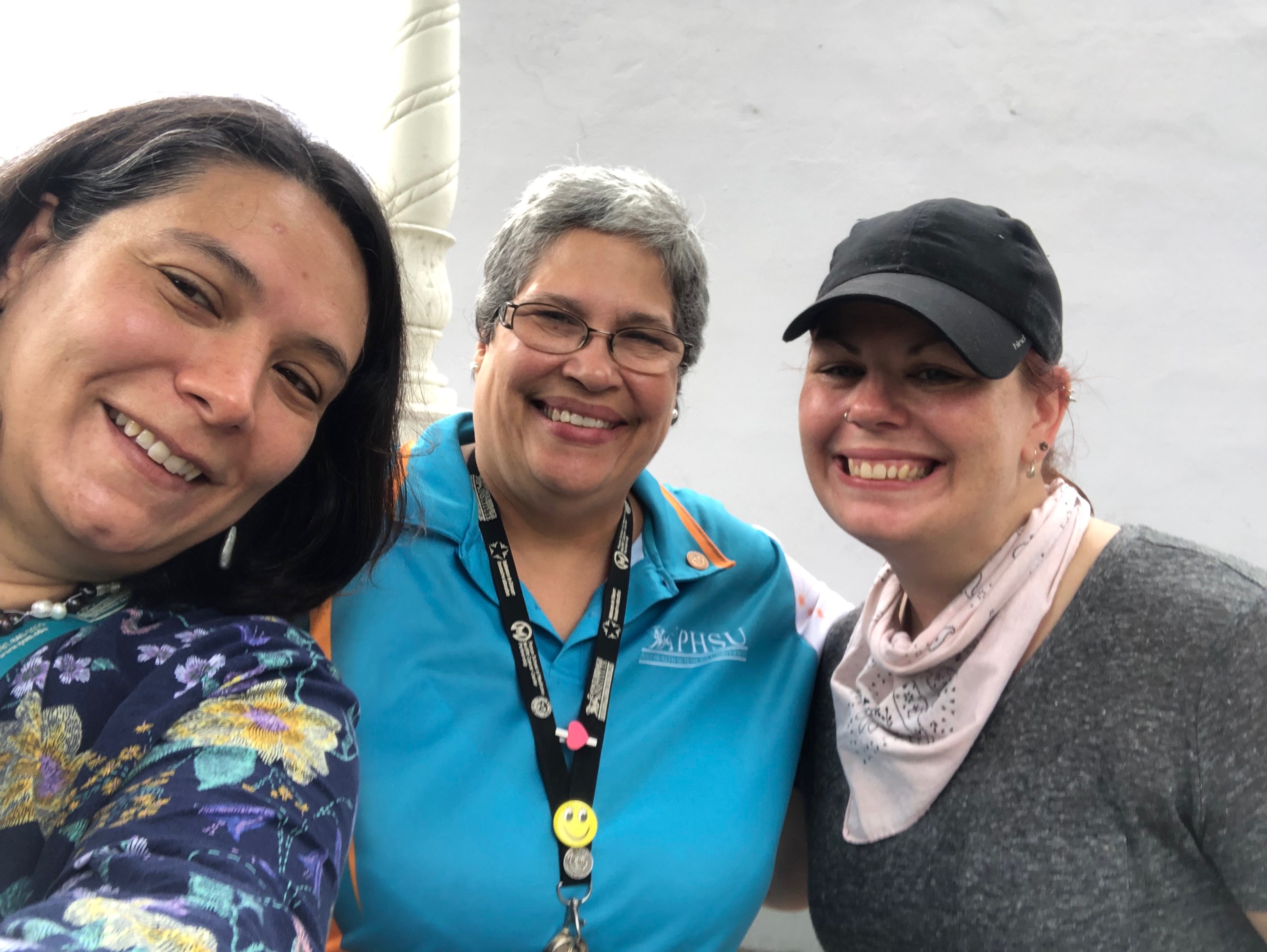
From Left to Right: Dr. Clara Isaza, Wallesca Rodriguez, and Deborah Kuzawa. Dr. Isaza and Ms. Rodriguez are from ponce Health Science University. Dr. Isaza is a Buckeye herself; she received her Ph.D. from Ohio State. Ms. Rodriguez coordinated all of our work in Ponce and Adjuntas. Without Wallesca, our work in Ponce and Guilarte may not have happened.

Embracing uncertainty was probably the most challenging aspect of this project for many participants.  My response to many questions about trip details was a smile, and “we will respond to the needs that are present when we are there,” because we didn’t have a final itinerary of the two weeks until close to the trip started, and generally did not know what we would be doing for our service partners until we arrived on site—and sometimes even then, there was uncertainty about what needed to be done and what could be done by our group. Some of the organizations did not have regular volunteers, so it was a learning experience for everyone. Sometimes our tools and resources were less than adequate for the tasks, but in the Puerto Rican spirit, we made what we had work for us to the fullest extent possible. By the end of the trip, I think we all better appreciated how community service is about the community, its culture, and its immediate needs, and that necessarily means a bit of uncertainty in the process.

More street art in San Juan.

We also discovered that our group’s can-do attitude, openness, and willingness to learn and work hard made us stand out to our service partners.  I was proud to see everyone engaging fully with Puerto Rico—people, food, nature, culture— asking questions in English and Spanish of nearly every person we encountered, from the Uber/taxi driver, to the tour guide, to the servers and employees of the places we stayed and our service partners.  We were able to hear about the experiences and perspectives of a wide range of Puerto Ricans from around the island, helping us better understand the diversity among Puerto Ricans and in turn better understand what it means to be an American from the Caribbean.

Building cover in art on Calle Loíza in San Juan.

We could see and hear how much the island—people and environment—has recovered from María and the delayed recovery efforts, but we also heard about and saw where there are still gaping holes in recovery. Hundreds of schools remain closed because the damage was so great, and now, the population has dispersed so much that schools are being consolidated and students bussed.

The W School (one of our service partners), for example, has a quarter of the students it had before María, mostly because families moved away. Families couldn’t survive months and months, hundreds of days without power or water or access to food and other necessities, so they relocated to other parts of the island or the mainland United States.

View from the Centro de Resiliencia en la Comunidad; the rain coming in obscures the top of the mountain.

Similarly, we worked with Centro de Resiliencia en la Comunidad in San Salvador, Caguas, a rural mountain community about 45 minutes from San Juan. Its students are bussed 20-40 minutes away for school because the local schools have not reopened or reopened and then closed. With narrow, steep, and winding roads and overall challenging (but beautiful) terrain, the community was told after María that help would not be coming any time soon, if at all. As a result, the community has been working on becoming an electricity and water co-op, pointing to a positive outcome in many communities (and this one in particular) post-María—the strengthening of community collaboration and unity.  Community and kindness seem to be the hallmarks of Puerto Rican life.

View of Old San Juan and the sea from Yohaku Tower in El Yunque.

From a tourist point-of-view, we had to adjust our expectations of the landscape and natural areas, such as in El Yunque. As the photos demonstrate, it was breathtaking.

In El Yunque.

But we wanted to hike, many of the trails still closed due to hurricane damage. Swaths of the mountains still bear the scars of María, with stripped spindly trees looking like the survivors of a fire still visible among the lush, new growth.

Flecks of pyrite (and maybe a little gold!) from the shore of the Mameyes River in El Yunque. In the background, the lighter colored sand is all pyrite and gold (about 70/30).

The natural areas are slower to recover after hurricanes because people generally worry more about meeting the basic needs of those on the island. However, as Dr. Francisco Murphy from Adjuntas and Ponce Health Sciences University pointed out to us, the natural areas are central to both the health and identity of the island.

Drone photo of some of the group at the Guilarte work site.

Luckily, we worked in Monte Guilarte Forest with Dr. Caridad Báez Mendizabal and Ron Miller from the Department of Natural Resources.  All the students (and myself) liked this service work the most because of the gorgeous mountain, sub-tropical rainforest surroundings, and perhaps most because at the end of each workday, we could see the progress and could feel the (physical) impact of hauling corrugated roofing and wood up a steep, rocky hill.  We worked on cleaning debris and repairing camper cabins that used to be rented out. The DNR did not have a timeline for when these would re-open to the public. After our two workdays, they estimated that they would be open in about 2 months, bringing some income to the DNR.

Trail markers (more love & less garbage) on our way to water holes in Guilarte.

Dr. Murphy told us that due to our presence in Adjuntas/Guilarte, local groups have decided to volunteer in the forest and local companies have donated goods. He said, “you have had a domino effect you cannot see the impact of.”  I think this sums up our service experiences and service work in general: we can never truly know the small and big impacts of our work, the ways in which service and kindness can radiate out like a pebble dropped into a pond.

Art on cart/kiosk on the Plaza las Delicias.

In Ponce, we worked in Plaza las Delicias, painting the cement walls of the garden beds. The Plaza is always busy—it has been the center of Ponce for four centuries—and passing Ponceños would say “gracias” or “thank you” or stop to ask us questions about who we were and what we were doing, sometimes in English, sometimes in Spanish, and often a mix of both. One man observed me working for a moment, and launched into Spanish way too fast for me to completely understand, but then said in slower English, “if more persons did good work like this then more persons would do good work and everything would be better.” A seemingly homeless woman said, “thank you for making Ponce beautiful.” Everywhere we went people were warm, welcoming, and always willing to chat about their lives, about our lives, about where our lives meet.

Vejigante mural in Ponce. The building in front is common sight in Puerto Rico: part crumbling, part refreshed, in a state of in-between.

Being able to chat and connect with ordinary Puerto Ricans was one the best aspects of this experience. We hope that seeing us volunteering inspired others to consider how they might serve their community and others to improve the world and themselves.

Mural in Ponce.

Our opportunity to serve Puerto Rico and better understand the island—the values, cultures, people, and language—created opportunities for us to better understand ourselves, to better understand what it means to be an American, and what it means to serve others. We hope our service may be an opportunity for others, including our fellow Buckeyes, to engage and consider how they might also continue to serve the island and their own communities.

Social and political commentary manifested in a small piece of street art (in Ponce).

Service is why I am a STEP mentor; I see the goals of STEP as fostering connection with/between students and aiding their transformation. Through this trip, I learned that mentoring, like service, is definitely a two-way street. This project has transformed me in ways simple and in ways I am still trying to understand.

Siempre hay opportunidad.

There is always an opportunity to be kind, to help others, to consider your communities.

¿Cuál es su próxima oportunidad para retribuir?

¿Qué oportunidad crearás a continuacion?

Featured

Puerto Rico, como siempre, se levanta.

Green mountains and rolling hills, white clouds, and sea in the distance.
View from Yokahú Tower in EL Yunque.

Puerto Rico, como siempre, se levanta.

— Melina Willis
Guilarte State Forest.

Puerto Rico is a land of resilience. You can expect to be wowed by the way the wildlife bounces back after disaster, the way the people come together in times of need, and the way the air seems to breathe strength into you. The island is powerful and beautiful. The people are kind and welcoming. No matter where you are or who you are, people will smile and wave. The culture of love seeps into everything: the houses, the streets, the food, and the music. You will hear music everywhere you go: some salsa, some bomba, and the singing of the coqui. Every town has something different that makes it special, and everything is tied together by such a rich and turbulent history.

You will never be bored. 

You should know that everyone will talk to you. Absolutely everyone. I expected the friendliness, but I definitely wish I had been warned about how easy it is to fall into endless conversations with random people on the street. I definitely learned to build extra time into the walks to and from places. The people were easily the best part of the trip though.

Antony (ISLA instructor) and Melina

There was just so much to learn from them, so much passion and strength. Everyone had a story to tell or a restaurant to suggest. A lot even had family in Ohio. Moving from place to place became bittersweet because of having to say goodbye to  people. That was probably the hardest part in general, learning so much about the people we met and stayed with, and not being able to spend more time with them or help them more. It was hard to leave them knowing that what was only a 3 or 4 day experience for us, was their reality. But the Puerto Rican people are strong and their resilience is one of the most beautiful things I’ve ever seen. Everyone we spoke to had a positive outlook and an open heart, and because of them my six word memoirs are 1) Puerto Rico, como siempre, se levanta and 2) I’ve never felt more at home.

Hanging out by a waterfall in El Yunque.

Esperanza en la cara de adversidad.

Luquillo Beach.

Dear Puerto Rico, siempre hay esperanza.

— Sarah Beth Dunn

Puerto Rico is a place of immense beauty, and though it is small, it boasts a rich cultural heritage and ecological diversity to explore. Be prepared, however, for while the destruction of the hurricanes is evident in the island’s material goods, it left a profound scar on the people of the island as well. Natives are brought to tears not out of their own plight but rather out of the plight of their neighbors and friends. Homes, businesses, and schools are deserted, and many sit slowly deteriorating. Nevertheless, these observations shall be a reminder of the strength of the people rather than the destruction of the hurricanes. 

In Guilarte State Forest with Ron Miller.

I expected there to be differences between life on the island and life in the contiguous United States, so I was more surprised by how similar life is. Looking back, however, this really should not have come as such a revelation. I have always been a proponent of the idea that people are often more similar than we think – that perceived differences can be more divisive than actual differences – but this trip was the first time I was able to observe this philosophy extend across cultures. Another aspect of thinking I was surprised this trip challenged was my approach of American politics. Many Puerto Ricans we met openly acknowledged the faults of their government while still nursing a deep love and admiration for their island, which I think is a valuable lesson: to acknowledge one’s shortcomings while appreciating one’s potential. It gave me a new appreciation and view of what it means to be an America citizen. 

Though the natural beauty of the island is stunning, I think the relationships we built with people were the best aspect of the trip. The first week, three other women and I stayed at a host family’s house, and I realized how similar people are despite cultural differences. As the nature of our trip was not just tourism, I found that I wished I had known more Spanish or been more advanced in my speaking skills. I suspect that would have allowed me to make even closer connections with the people of the island, and I would love to have talked with them about their opinions and beliefs on a deeper level than I could.

I also wish I would have looked up pictures of the island to prepare myself for the wreckage. The hardest part of the trip for me was observing the façade of life in places destroyed by the hurricanes, areas that often loomed on the outskirts of the booming tourism industry. However, the island is also a place of incredible beauty.

It is difficult to pick just one sight or sound as the most beautiful of the trip, but one that is symbolic for me was the sound of Luquillo Beach. I remember people talking and laughing, the sound of Marc Anthony on the radio, the palm leaves brushing in the wind, and of course the waves breaking and receding back into the ocean. These sounds reminded me that Puerto Rico is an island focused on community and life, and like the ocean that surrounds it, it persists.

OSU representing at La Guancha in Ponce.

Hace mucho calor pero mucho chevere.

Hanging out in front of a waterfall in El Yunque.

Hace mucho calor pero mucho chevere.

— Luke Breininger

Working and learning in Puerto Rico changed my view on the world quite a bit. The trip showed me that Puerto Rico received little aid from the United States, even though it is a territory (if a state were hit by a hurricane that would receive plenty aid and help quickly). Being in Puerto Rico just made me look at the things that I have in my life and become more appreciative of them.    

Also, I was immersed in the Puerto Rican culture, and they are great people. They were very   grateful for us being there, they would come up and say thank you for helping and have a conversation with us.  My host family was very gracious and welcomed us into their home and family. They taught us a lot about what happened during the hurricane, and their lives. This was amazing and eye opening.

When staying in working in Puerto Rico there was a lot of different interactions that influenced my perspective. First off, my host family was telling us how the power companies rip everybody off down there. This made me appreciate AC because for the whole week in our house we did not have AC and we had to turn off our fans during the day to conserve energy and money. Remember, it was like 90 degrees at 7:30 a.m. Along with this and many other things I learned from my host family. They also spoke Spanish, so it was interesting to be in a Spanish home and be able to learn. Overall, they were very influential to me.

The hugging tree in Loíza.

Another profound moment is when we were at the “W” school helping move stuff and open a new classroom. The woman that runs it was so sweet and nice. She was telling us what her, her family, and students had gone through with Hurricane Maria. She began to cry. At this moment it really struck me how much these people had gone through, and how little help they had received. The amount of strength it took from all Puerto Ricans to recover from that storm is unfathomable.

Finally, we were working in the forest on some destroyed cabins, and they were telling us that we had started something; more people wanting to help. We were the first college group that had come and helped in many of those places, and now they had already started receiving calls from colleges, churches, and other people to come help, and that felt amazing that we could start something like that.

Admiring handiwork after removing part of the collapsed cabin roof.

This change in me is valuable to my life because first, I learned a lot of new Spanish and became better at speaking it. Also, I learned a lot about the Puerto Rican culture, and this broadened my mind so that I am better able to understand where this group of people comes from and what they have been through over the years.

Also, for the future I know that speaking Spanish could be very beneficial in my ability to communicate, so I hope to continue learning and bettering my Spanish.

Esperanza para el futuro.

Esperanza para el futuro.

— Brooke Babbin

Puerto Rico is a beautiful Caribbean island that is also a U.S. territory. Throughout Puerto Rico, you will encounter a great variety of landscapes including beaches, mountains, and El Yunque National Forest. Temperatures are fairly hot year round, as the island’s average temperature is 82.4 °F throughout the year. The capital of Puerto Rico is San Juan, where you can find the rich culture and history of Puerto Rico and the tourism that has overtaken the island.

Ponce #PuertoRicoesOro Puerto Rican flag.

Other notable cities to explore while in Puerto Rico are Adjuntas and Ponce. Adjuntas is a quiet mountain town in the midwest of the island. Adjuntas is a perfect destination to visit if you are looking to disconnect from society and explore the unique nature native to Puerto Rico. Ponce is a large coastal city on the southern part of the island named after Spanish conquistador Juan Ponce de Leon. Ponce further explores the heritage of Puerto Rico through its Creole architecture, diverse museums, and its historic district three miles from the shores of the Caribbean Sea. In September 2017, Puerto Rico was devastated by hurricanes Irma and Maria, and the efforts to rebuild the island are still in progress today.

Silliness in the interior courtyard of the mayor’s offices.

Before traveling to Puerto Rico, I wish I had known how Americanized the island is, and the great impact the American culture and economy have on Puerto Rico. Additionally, I wish I was aware of how Puerto Rico’s status as a U.S. territory impacts its citizens and its role in American politics. Furthermore, I was also unaware that the majority of the population of Puerto Rico can speak some English. Throughout this trip, I learned about the horrific aftermath of hurricanes Irma and Maria and how the people of Puerto Rico managed to survive months without electricity and water due to the hurricanes.

Personally, the best thing about this trip was the service aspect. It was so encouraging to see how our efforts helped to improve the overall well-being and spirit of Puerto Rico. I truly enjoyed assisting local organizations in taking steps forward to rebuild themselves after the hurricanes. The hardest thing about traveling to Puerto Rico was the language barrier. Since Spanish is not a language I regularly speak, I found it difficult to have confidence in my ability to communicate with the Puerto Ricans I encountered. In addition to the language barrier, I also found it very challenging to acclimate to the hot and humid conditions throughout Puerto Rico.

Ponce before a storm (at Vistas).

Finally, the most beautiful thing I saw while in Puerto Rico was El Yunque National Forest. El Yunque was unlike any forest I have ever seen before, and it is the only tropical rainforest in the U.S. Forest System. If I ever travel to Puerto Rico again, I would love to return to El Yunque to further explore its lush vegetation and roaring waterfalls. 

Puerto Rico preserva por la adversidad.

Ponce, right before a storm.

Una odisea que me guió por el conocimiento.

— Ryan Leahy

My STEP signature project was a two-week cultural immersion and service-learning trip in the U.S. territory of Puerto Rico. Puerto Rico is a vibrant Caribbean island that boasts natural beauty not only from its beaches, but its tropical rain forest and inhabitants that reside there. The hot and humid climate really brings to life the contrasts of an Ohio spring to a tropical Caribbean location. The people of Puerto Rico possess a rich culture that is infused with the native indigenous Tainos, Spanish European immigrants, and African cultures. Puerto Rico has been home to the indigenous Tainos for many centuries, while European culture didn’t touch the island until Spanish Christopher Columbus’ arrival in 1493. Puerto Rico was under Spanish control until 1898, when the U.S gained control after the Spanish American War. Since then, Puerto Rico has been a U.S. territory, and in recent years has been considering the possibility of statehood. Just recently, Puerto Rico was devasted by hurricanes Irma and María, that still have lasting effects 2 years later. Experiencing the Puerto Rican culture firsthand was an amazing, transforming project to utilize my STEP funds.              

With Patricia, host home matriarch.

The two weeks included a one-week homestay with a native family in the city of San Juan, and the next week traveling to the regions of Adjuntas, Ponce, and back to San Juan.  The first week I, along with eleven fellow buckeyes took Spanish immersion classes in San Juan and volunteered at various organizations during the week, as well as explored the San Juan area. During the second week, we volunteered in the other parts of the island, and it included more free time to explore popular Puerto Rican destinations such as: El Yunque, Bio Bay tour, Isla Verde beach, and many more.

Before traveling to Puerto Rico, I wish I had studied my Spanish skills enough to have the confidence to communicate effectively. On arrival, I was timid with my Spanish language skills, not knowing if I was saying the right words or pronouncing the terms correctly.  However, after the first week I was able to effectively communicate my ideas to the native speakers more often than when arriving on the island. I can only imagine what just two weeks of practice before coming to the island would’ve resulted in.  It was frustrating, however, to try and utilize this opportunity and use Spanish with native speakers, only for the opposing converser to use plain English as a response. This was more common in the populated capital of San Juan, than the mountain community of Adjuntas and the city of Ponce.

In Adjuntas on the way up to Guilarte; the river formed many natural pools and small waterfalls.

During this journey I learned that the people of Puerto Rico are resilient but loving. My host family showed us compassion through inviting meals, transportation to classes, advice, and especially sincerity. Although the only people living in our host homes was the 60-year-old couple, we were able to meet and spend time with: their 35-year-old niece from Chile, their two sons, and their families. They were very kind to us and treated us as one of their own blood relatives. After hearing about the horrors of the 12-hour hurricane landfall, it is unbelievable to imagine all of the pain and suffering the people of Puerto Rico had to and are still enduring. The service aspect of the trip was awesome to see some of the ways we could help directly; and to see the joy on those around us we were helping made it all worthwhile.

The part I most enjoyed from my STEP signature project was the strong bond created not only within our group, but with Puerto Ricans we were able to converse with and learn more about the culture firsthand. It was awesome experiencing watching and being involved in a group that grew closer together over the highs and lows of the two weeks we stayed in Puerto Rico. Whether it be our host family, the bus drivers, those from organizations we were volunteering with, or tour guides, I feel like I learned more from them about the island of Puerto Rico than I can learn in any textbook. As an engineering student with a Spanish minor, this experience has transformed me to effectively communicate, and build relationships with those around me, in Spanish or English. Moving forward, I will use this experience for the betterment of myself and those around me.

Post-turban lesson at Parque Histórico Cueva María de la Cruz.

Monociclos, Mofongo, y Baile: Oh Mi.

O-H-I-O in El Yunque Rainforest.

Monociclos, Mofongo, y Baile: Oh Mi!

— Lauren Beard

Puerto Rico is an island that is rich in culture and diversity at every corner. While there are lovely beaches all around, there are also beautiful mountains, a breathtaking rainforest, and fascinating marketplaces. However, in some locations, Puerto Rico is still struggling with wreckage from the hurricanes as many people fled the island afterwards and never returned. The people we met had an extremely strong work ethic and a great sense of pride for their culture. They were also very welcoming and understanding of the language barrier and would make their best effort to cater towards us. Additionally, there is art and music on every street that is both lively and historical in content. Each part of the island has a different feel from hectic city life to slow and relaxed mountain life. Whatever you are looking for, you will be able to find it in Puerto Rico.

With the ever-changing umbrellas on Calle Fortaleza .

Before I came to Puerto Rico, I wish that I had known and practiced more Spanish. I often felt guilty of having native Puerto Ricans have to cater to my needs by speaking in English. If I had known a bit more Spanish to be able to carry conversation, I feel that my efforts would have been much appreciated the language barriers would not have been as prevalent.

The biggest takeaway that I have learned during this trip is the power of service. Witnessing how grateful the people working for various schools, community centers, parks, etc. were has helped me understand that I have the ability to create great change in the world even if the tasks seem small. For example, picking up rusted screws from a park can offer a child somewhere safe to play or cleaning a community kitchen can provide a sanitary place for families to cook meals. Even the smallest act of kindness has the potential to change someone’s life. Each person I met in Puerto Rico offered a new insight or valuable lesson that I will cherish forever.

Working hard in Guilarte State Forest.

The best thing about this project was the people. We had an amazing group made up of students and Dr. Kuzawa that made everything about this trip exciting and fun. Each day we also had the opportunity to meet someone new with a different and inspiring story. Being able to experience such a wide variety of personalities and discovering everyone’s diverse background was both intriguing and enlightening. 

The hardest part about the project was the language barrier. My Spanish language skills are relatively weak so being able to take lessons with the Institution of Spanish Language Acquisition was extremely helpful. While partaking in several of the service projects, people of the local community would come up to me and try to hold a conversation in Spanish. Although I could understand people for the most part, it was difficult for me to formulate a response.  I struggled to come up with ways to respond when my Spanish is so minimal. 

The most beautiful thing that I saw in Puerto Rico was the “El Velorio” painting that we had the chance to see at the University of Puerto Rico. This massive piece of art by Francisco Oller depicts “the wake” of a peasant child. In the 1800s, when the work was created, it was a tradition among peasants to celebrate the death of a child. The reason that I found it to be so beautiful, despite its tragic context, is because it gives in interesting view of the Puerto Rican culture at the time. Within the painting there are so many emotions, expressions, and events occurring and the level of detail included is impeccable. I have truly never seen any piece of art that is able to tell so many differing stories all at once.

Plaza los Delicias in Ponce.

Una hermosa isla con gente amable.

Post-bomba lesson in Loíza at the Parque Histórico Cueva María de la Cruz.

Una hermosa isla con gente amable.

— Juliana Discher

This trip was a life-changing experience that I will take with me for the rest of my days. Puerto Rico is a quaint island filled with rich history and kind people. The Puerto Rican community was incredibly friendly and welcoming of us. The terrain on the island is incredibly diverse—they have mountains, oceans, rainforests, and deserts. The most beautiful thing I saw was the sunset after we kayaked to the bioluminescent bay. It had gorgeous colors and it came after we did some intense kayaking. San Juan, the capital, is a happening city with a lot to learn about and to explore. I would recommend Puerto Rico as a travel destination for anyone.

At the beach at La Guancha, the historical boardwalk area in Ponce.

One of the best parts of the trip were all the people I got to interact with. The people were so easygoing and friendly. I got along so well with the other students. For example, one of the most unfortunate parts of the trip was that my phone broke in the airport flying to Puerto Rico. I had to go two weeks without a phone, but luckily the other students were incredibly helpful and kind about letting me use their phones when I needed. It ended up being therapeutic to be without my phone. 

O-H-I-O! In El Yunque Rainforest.

I wish I knew more about what to expect before this trip occurred. There was a lot of unknowns which were stressful for me as a planner and detail oriented person. However, from this I learned that flexibility and calmness help the overall success of the trip and for me to have more fun. You just have to go with the flow and trust that things will work out. Once I let go and had this trust, my experience was phenomenal. I felt sometimes like we were not as productive as we could be at the service sites. Sometimes I felt like the sites were not prepared for us to come and we could have maximized our time there better. I was able to overcome this by keeping a positive attitude and to work with what I was given.

Gorgeous view at Vistas in Ponce.

This trip has transformed my views of being an American a bit. I see the importance of looking out for your neighbor more. It reinforced my view that America is a diverse place and we need to continue to uphold and celebrate that diversity. This trip made me feel that Puerto Rico needs more support from the federal government.

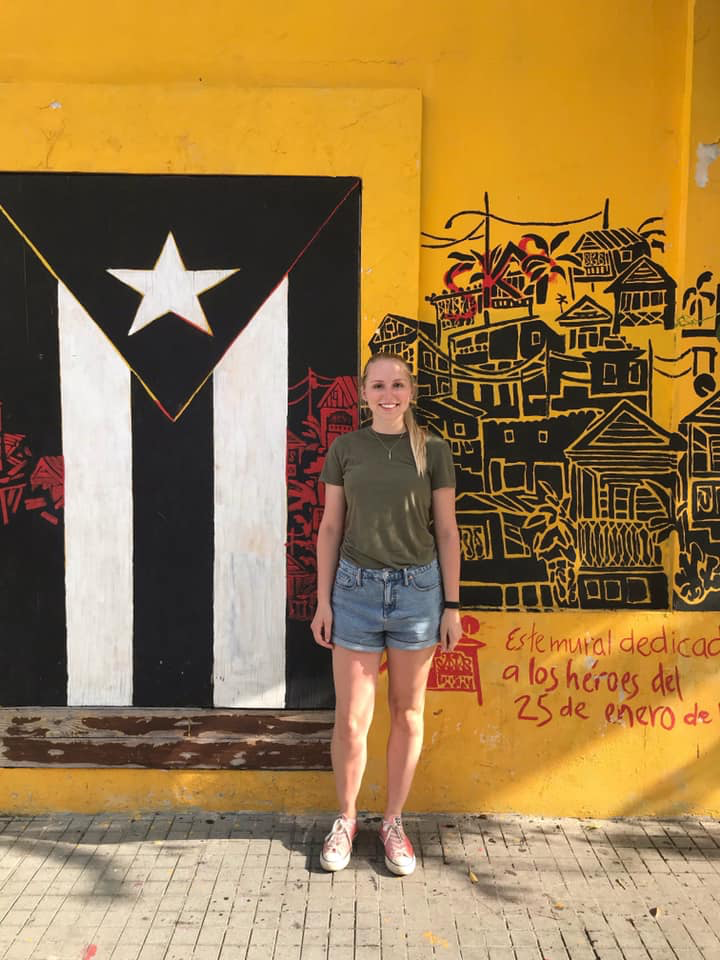
In front of a mural dedicated to the Calle 25 de Enero in Ponce.

Adjuntas, hombre. Guanabana y Bomba también.

At the University of Puerto Rico—Río Piedras,.

Adjuntas, hombre. Guanabana y Bomba también

— Hannah Commune

Puerto Rico is similar to the United States in many aspects, but has its own unique culture, cuisine, and climate. Although many Puerto Ricans speak English, having a little experience with the Spanish language is very helpful for navigation and really getting to connect with locals. I enjoyed being able to practice my Spanish on the island because I felt that I was truly being immersed in the Puerto Rican culture.

A typical Puerto Rican meal usually consists of rice, beans, meat, and some form of plantains. Some of my favorite foods were Mofongo, Alcapurrias, and Tostones with mayo ketchup. Along with these authentic dishes, Puerto Rico has many chain restaurants and convenience stores that are found all over the States.

For a tiny island, Puerto Rico has the same, if not more, biodiversity compared to the entire continental U.S. The stunning El Yunque rainforest stretches across the northeastern part of the island, while the southern part of the island is hotter and drier. Mountains surround the town of Adjuntas, and some of the most beautiful beaches are Luquillo and Isla Verde. Puerto Rico also holds three of the world’s bioluminescent bays. 

At the work site in Guilarte State Forest, with Department of Natural Resources’ Ron Miller.

During this trip, I learned so much, but perhaps the most important thing I learned was the importance of people. I met so many different people on this trip, more than I would typically meet in a day back home. Many, if not all of these people, made a lasting impact on me, or allowed me to look at the world from a different perspective.

Sonia and Adriano, my host parents for the first week, were some of the kindest people I have ever met. The two of them also presented me with this statement: almost all of the world’s problems arise from religion. I had never considered this before, and their statement made me step back for a moment and really think.

Cecil, the woman running the W school, shared her personal experience dealing with the aftermath of hurricane Maria. Her story was heartbreaking, but it allowed me to better understand what exactly was happening in Puerto Rico for five months after Maria. My fellow traveling companions also opened my eyes on this trip. Most of us did not know one another well prior to going on this trip, but I am so grateful for that. I was able to look at our experiences from several new perspectives, and truly enjoy them.

 The best part about this trip was completing a variety of different service projects while on the island. Although some of what we did may have felt small, I know it made a big difference to the people we were able to help out. My favorite service we did was cleaning and restoring the cabins in Adjuntas. Physically moving large pieces of metal, and sweeping the floors was hard work, and I am so glad we were able to do it. The most beautiful thing I saw in Puerto Rico was the sunset on our last night on the bioluminescent bay tour. I felt a sort of peace with myself I had not felt in a very long time. The sunset was a wonderful end to a fantastic two weeks of service and culture immersion. 

Adjuntas, Man. Guanabana and Bomba too. 

Adjuntas, hombre. Guanabana y Bomba también.

Design a site like this with WordPress.com
Get started